Walk into any supermarket in India and you will find dozens of jars labelled "100% Pure Honey." Yet laboratory studies have repeatedly found that a large percentage of commercially available honey in India is adulterated — diluted with rice syrup, corn syrup, or inverted sugar solution.
Understanding the difference between raw honey and processed honey is not just a matter of taste preference. It determines whether the jar you bought is a genuine superfood or an expensive bottle of flavoured sugar syrup.
What is Raw Honey?
Raw honey is honey in the state it exists inside the beehive — extracted gently and bottled without any significant heat treatment or fine filtration.
The process is straightforward:
- Beekeepers uncap the wax cells and spin the honeycomb frames in a centrifuge at low speed.
- The extracted honey passes through a coarse mesh strainer to remove fragments of beeswax and debris.
- It is poured directly into jars.
That is it. No heating, no micro-filtering, no additives.
Because of this minimal processing, raw honey retains everything the bees deposited in it:
- Active enzymes like diastase and invertase (responsible for the characteristic aroma and digestion support)
- Natural bee pollen — the microscopic protein-rich grains that give the honey its floral character and serve as a traceability fingerprint
- Propolis traces — the natural antibacterial resin bees use to seal the hive
- Natural organic acids that contribute to the honey's low pH and long shelf life
Raw honey looks slightly cloudy, varies in colour from batch to batch, and will naturally crystallise over weeks or months. This is not a defect — it is evidence that the honey is real.
What is Processed Honey?
Processed honey goes through two industrial steps that fundamentally alter its composition.
High-Temperature Pasteurisation
Commercial processors heat honey to temperatures ranging from 60°C to 80°C for several minutes. The stated reason is to kill yeast and prevent fermentation, extending shelf life. The side effect is that this heat denatures active enzymes and reduces naturally occurring antioxidants and organic acids.
Processed honey heated this way becomes uniformly thin and stays liquid indefinitely on a supermarket shelf — but it has lost most of the biochemical complexity that makes raw honey nutritionally distinctive.
Ultra-Filtration
After pasteurisation, the honey is forced through microscopic filters under high pressure to produce a crystal-clear, perfectly uniform liquid. This process removes all bee pollen.
This matters for two reasons:
- Nutritional loss: Pollen contains amino acids, vitamins, and bioflavonoids not present in the base nectar.
- Traceability loss: Pollen is the DNA fingerprint of honey. Without it, the geographical origin of the honey cannot be verified, and the detection of common adulterants becomes significantly harder.
Adulteration in the Indian Market: The C3 and C4 Sugar Syrup Threat
India's Centre for Science and Environment (CSE) and multiple independent laboratories have published reports showing widespread honey adulteration in the country. The most common adulterants are:
- C4 sugars — derived from sugar cane or corn. These are detectable by standard Carbon Isotope Ratio (CIR) testing.
- C3 sugars — derived from rice, beet or fruit. These are harder to detect by CIR and require more advanced Nuclear Magnetic Resonance (NMR) spectroscopy to identify.
Both these syrups are cheap industrial by-products. When blended into honey in small amounts, they increase the volume of the final product at a fraction of the cost of real honey.
Ultra-filtered commercial honey is particularly vulnerable to this type of adulteration because, without pollen, there is no botanical trace left in the product that can link it to a specific floral source or region.
Raw honey from traceable apiaries is far more resistant to this type of undetected adulteration precisely because every batch carries pollen — a natural, verifiable record of where the bees foraged.
Key Differences: Nutritional Value & Health Benefits
| Property | Raw Honey | Processed Honey |
|---|---|---|
| Active Enzymes | Present and active | Significantly reduced or absent |
| Bee Pollen | Naturally present | Removed by ultra-filtration |
| Antioxidants | High (flavonoids, phenols) | Reduced by heat treatment |
| Crystallisation | Natural over time | Prevented artificially |
| Traceability | Verified via pollen analysis | Cannot be traced by pollen |
| Adulteration Risk | Lower — pollen provides fingerprint | Higher — no detectable botanical marker |
| Flavour | Varies by floral source; complex | Uniform, flat sweetness |
It is worth noting that both raw and processed honey are predominantly sugars (fructose and glucose). The nutritional distinction lies in the micronutrient and enzyme content that is lost through processing — not in the macronutrient profile.
Indian FSSAI Guidelines on Honey Purity
The Food Safety and Standards Authority of India (FSSAI) has established specific quality parameters for honey sold in India under the Food Safety and Standards (Food Products Standards and Food Additives) Regulations:
- Moisture content: Maximum 20% (raw honey typically contains 17–19%)
- Diastase activity: Minimum Schade units of 8 (diastase is a naturally occurring enzyme; heating destroys it, so low diastase is a marker of over-processing)
- Hydroxymethylfurfural (HMF): Maximum 40 mg/kg (HMF forms when honey is heated or aged; elevated HMF is a reliable indicator of overheating)
- Sucrose content: Maximum 5% (excess sucrose can indicate adulteration or premature harvesting)
- NMR Testing: Since 2020, FSSAI has encouraged NMR (Nuclear Magnetic Resonance) spectroscopy testing to detect C3 sugar syrup adulteration that evades standard CIR tests.
FSSAI licensed honey producers who comply with these parameters can legitimately print "FSSAI Certified" on their label. This is a minimum quality floor, not an organic or premium certification.
When buying honey in India, check for the FSSAI licence number on the label. It allows you to verify the manufacturer's registration status on the FSSAI portal.
Why Choose Honeyvan's Unprocessed Single-Origin Honey?
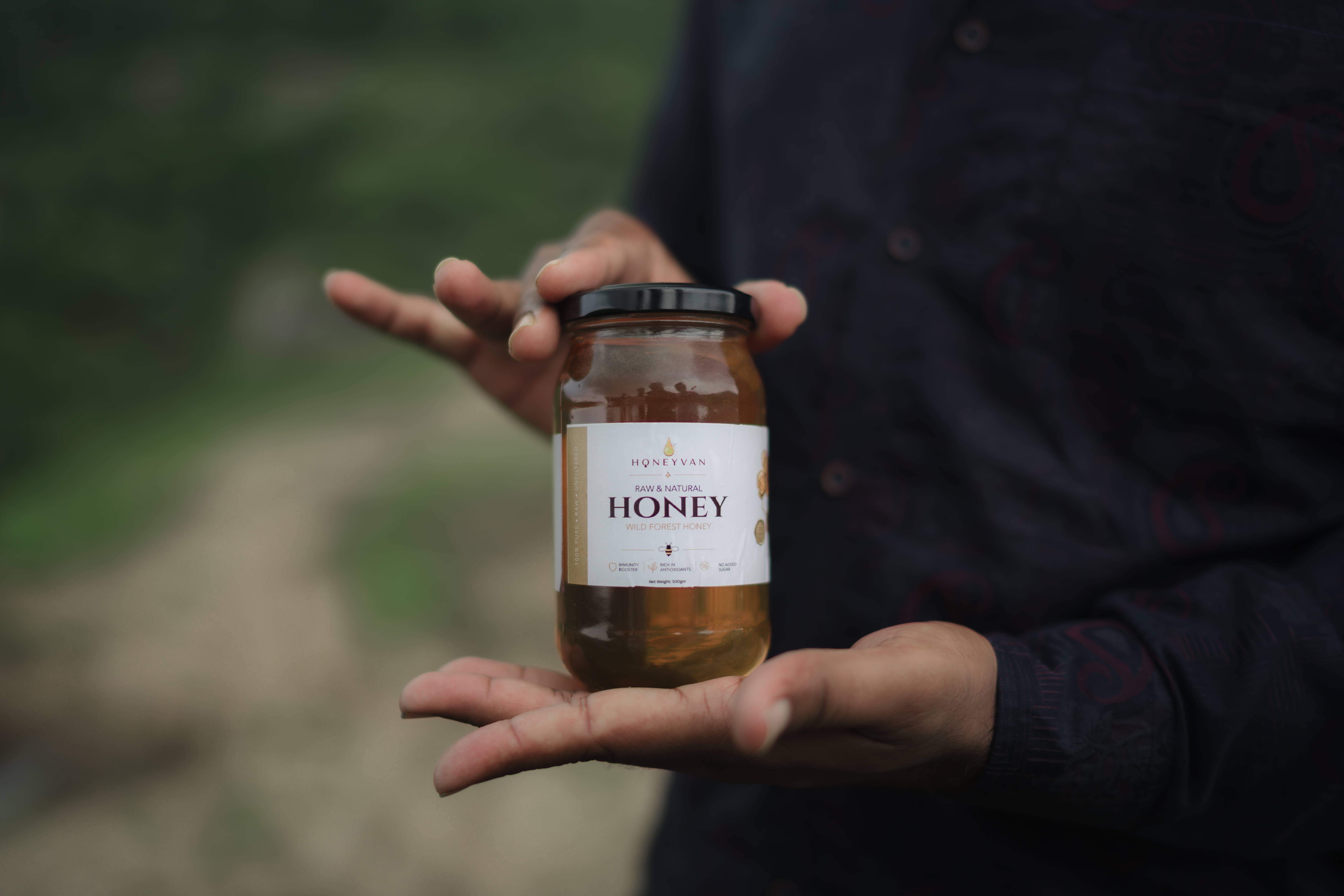
At Honeyvan, we are actual beekeepers — not a blending facility that sources and mixes honey from anonymous wholesale markets.
Every batch we sell comes from our own managed apiaries in Gujarat, Rajasthan, and Uttarakhand. Our extraction process is cold and gentle, our straining is coarse (never micro-filtered), and we do not apply external heat to the honey at any point from hive to jar.
The result is that every jar of Honeyvan honey:
- Contains natural bee pollen — verifiable and traceable to specific floral sources
- Retains active diastase enzymes — well above the FSSAI minimum
- Has low HMF — a direct result of never overheating the product
- Will crystallise over time — the most honest, natural signal that you are holding real, unprocessed honey
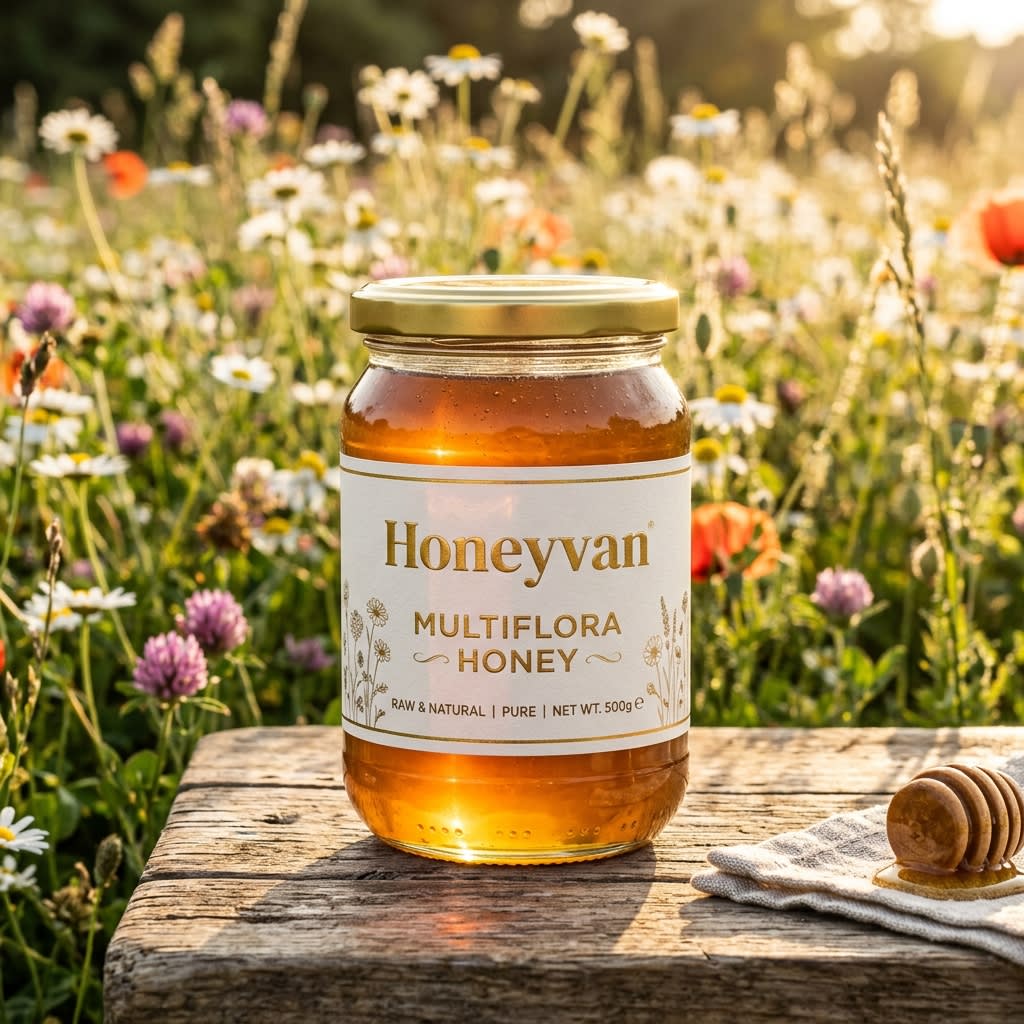
If you are ready to taste the difference between genuine raw honey and supermarket processed honey, start with our Raw Honey Collection. Our Raw Multiflora Honey is the most accessible starting point — a mild, balanced, everyday honey sourced from wildflower meadows.